🚗 Automotive Hall Sensor Tester – Non-Contact Ignition Coil & Electrical Diagnostic Pen 🔧
🚗 Automotive Hall Sensor Tester – Non-Contact Ignition Coil & Electrical Diagnostic Pen 🔧

BUNDLE & SAVE
Couldn't load pickup availability

🚗 Automotive Hall Sensor Tester – Non-Contact Ignition Coil & Electrical Diagnostic Pen 🔧
Stop Guessing.
Start Checking.
Tired of complicated engine-bay troubleshooting? Bring a more convenient way to your next electrical check. This non-contact Hall sensor tester helps inspect compatible ignition coils, relays, injectors and other automotive electrical components without needing direct electrical contact.

Check More Than Just Ignition Coils.
From ignition coils to relays and fuel injectors, modern engine bays contain plenty of electrical components to inspect. This compact tester is designed to help identify electromagnetic activity around a range of compatible automotive components, making it a practical addition to your diagnostic kit.
For preliminary checks around compatible traditional, dual-spark and single-spark coils.
Inspect compatible relay components without making direct electrical contact.
A convenient diagnostic aid for compatible injector troubleshooting.
Check electromagnetic activity around compatible solenoid components.
Add a preliminary signal check to selected automotive electrical inspections.
Useful for preliminary checks around compatible electrically driven fans.
Detect Magnetic Field Changes Without Direct Contact.
The built-in Hall sensor responds to changes in the magnetic field around compatible electrical components. The tester converts the detected response into an indication that helps you perform a preliminary inspection without first connecting directly to the component's wiring.

Choose the lower sensitivity setting when performing checks in situations with stronger surrounding signals.
Select the higher sensitivity setting when a more responsive detection setting is needed.
See What You're Checking, Even In Dark Spaces.
Engine bays are not always well lit. The built-in flashlight helps illuminate the area around the component while you work. Its slim pen-style body and pocket clip also make it convenient to keep nearby instead of searching through a crowded toolbox every time you need it.

Illuminates darker inspection areas around the engine bay.
Slim shape is easier to handle around crowded automotive components.
Keep the tester close at hand while moving around the garage.
Light And Sound Make The Response Easier To Notice.
During testing, the indicator lights and built-in buzzer provide feedback when the sensing tip detects a compatible magnetic signal. Instead of relying only on what you can see, you can also listen for the audible response while working around the engine compartment.

Indicator and buzzer responses are diagnostic aids. They should not be treated as a definitive confirmation that an automotive component is good or faulty.
Select. Position. Observe.
No complicated menus or bulky setup. Select the sensitivity setting that suits your inspection, position the sensing tip near a compatible component and observe the tester's response.
Switch from Power Off to Mode I or Mode II according to the testing situation.
Bring the sensing tip close to the compatible component being inspected.
Check the indicator and listen for the buzzer response as part of your preliminary assessment.
Battery Powered. No Diagnostic Cables To Manage.
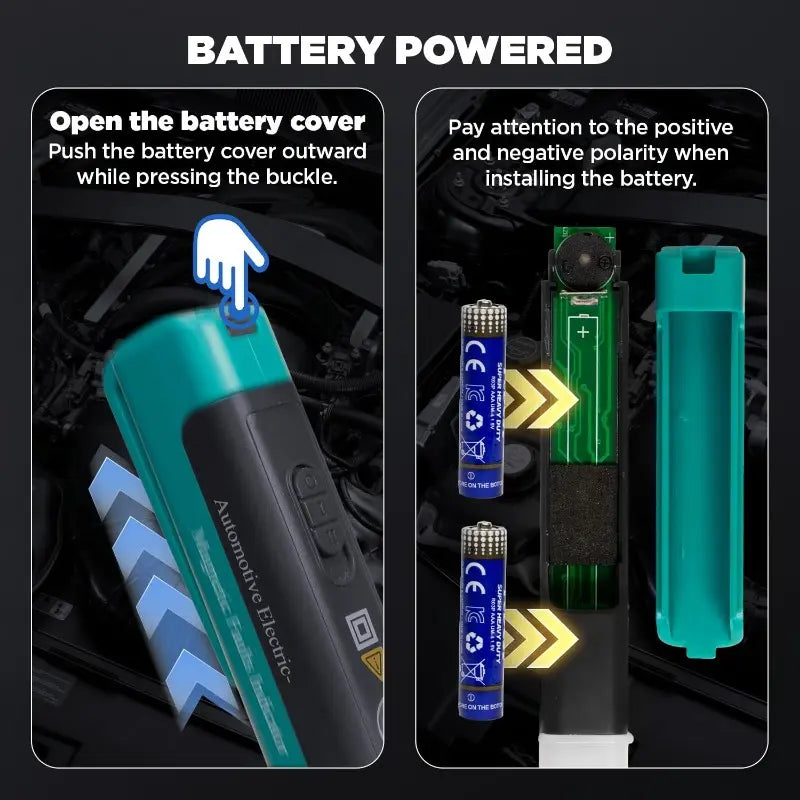
The self-contained battery-powered design keeps the tester free from external diagnostic cables during use. The battery compartment opens through the rear cover, making battery installation straightforward. Just pay attention to the positive and negative polarity markings before closing the cover.

A Handy Little Tester For Your Diagnostic Kit.
The black-and-teal pen-style body brings the main testing controls, flashlight function and sensing tip together in one compact tool. Keep it in your garage toolbox or service bag so it's ready when you need a preliminary automotive electrical check.

More Convenient Checks. Less Complicated Setup.
Responds to magnetic field changes around compatible electrical components.
Perform preliminary checks without direct electrical contact.
Switch between Low and High settings for different testing situations.
Helps illuminate darker inspection areas.
Provides visual and audible feedback during compatible tests.
Convenient to carry around the garage or workshop.
The Details At A Glance.
A Useful First Check, Not A Complete Diagnosis.
This tester is designed as a preliminary automotive diagnostic aid. A detected signal or indicator response does not independently confirm that a component is fully functional.
- Confirm that the component is compatible with Hall sensor detection.
- Follow the vehicle service manual and the tester's operating instructions.
- Keep hands, clothing and the tester away from moving belts, fans and hot engine parts.
- Do not touch exposed electrical conductors. Non-contact testing does not make every engine-bay area safe to access.
- Confirm suspected faults with appropriate diagnostic equipment such as a multimeter or professional scan tool when necessary.
A Few Questions Before You Start Testing.
What is an automotive Hall sensor tester?
It is a non-contact diagnostic aid that uses a Hall sensor to respond to magnetic field changes around compatible automotive electrical components. It provides preliminary testing feedback.
What automotive components can it test?
The product is designed for compatible ignition coils, relays, fuel injectors, solenoid valves, generators and cooling fans. Compatibility depends on the component and its electromagnetic signal.
Do I need to disconnect the wiring first?
The tester is designed for non-contact sensing, so many preliminary checks can be performed without making direct electrical contact. Follow the relevant vehicle service procedures before inspecting any component.
What is the difference between Low and High sensitivity?
The Low and High settings provide different detection sensitivity options. Choose the appropriate setting according to the testing situation and the manufacturer's instructions.
Does the tester have a flashlight?
Yes. It includes a built-in flashlight to help illuminate darker engine compartments and inspection areas.
How do I know when the tester detects a signal?
The tester provides indicator-light and buzzer feedback. Use the response as a preliminary diagnostic clue, not as the only basis for deciding whether a component is faulty.
Is it a replacement for a professional scanner?
No. It is intended for quick preliminary electrical checks. More complex faults may require a multimeter, professional diagnostic scanner or qualified inspection.
What batteries does it use?
The tester is battery powered and has a removable battery compartment. The exact battery type is not specified in the available product information. Follow the polarity markings when installing batteries.
Are batteries included?
The product images illustrate batteries during installation, but the package contents do not clearly confirm whether batteries are included. Please verify the selected package details before ordering.
Make Your Next Electrical Check More Convenient.
Non-contact Hall sensor detection. Two sensitivity settings. Built-in flashlight and audible feedback. Add a compact diagnostic helper to your garage toolkit and approach compatible automotive electrical checks with more confidence.
EXPLORE THE DIAGNOSTIC TOOL ↑