


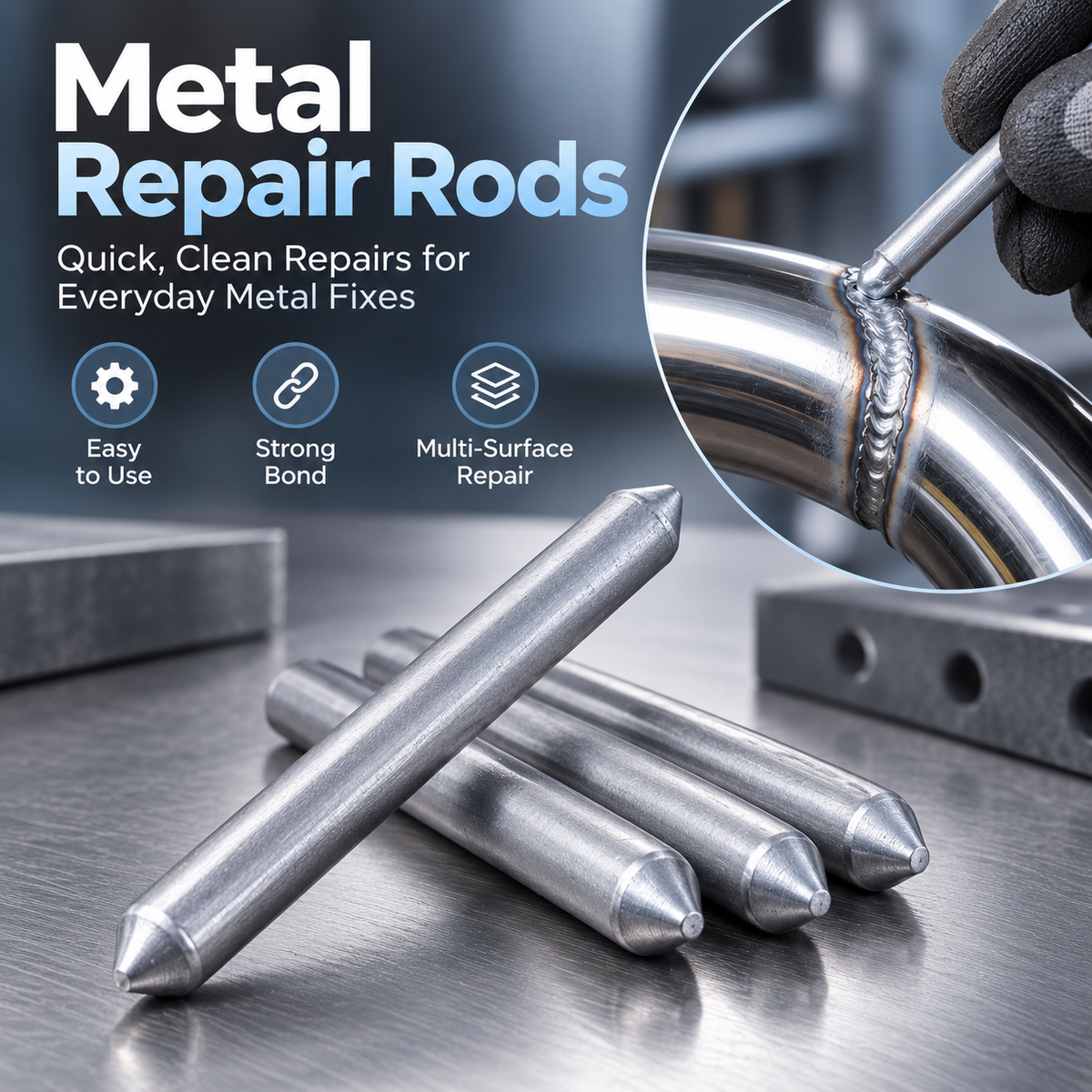
🔥Low-Temperature Flux-Core Metal Repair Rods – 6/12/24 Pack
🔥Low-Temperature Flux-Core Metal Repair Rods – 6/12/24 Pack

BUNDLE & SAVE
Couldn't load pickup availability
-
Ordered
- - -
Order Ready
- - -
Delivered

🔥Low-Temperature Flux-Core Metal Repair Rods – 6/12/24 Pack
Not Every Small Metal Repair Needs a Full Welding Setup.
Keep a compact set of torch-heated repair rods in the toolbox for compatible brackets, frames and small metal repair jobs where a filler-based brazing approach makes sense.

Sometimes the Repair Is Small. Setting Up the Equipment Isn’t.
A cracked non-critical bracket, hobby frame or compatible metal joint may not justify pulling out a complete arc-welding setup. These rods are positioned as a more compact heat-and-fill repair option.
The repair area may be only a short crack, gap or joint.
Large equipment can be more preparation than a small DIY repair needs.
Compact rods take little toolbox space until a compatible repair appears.

Made for the Kind of Metal Fix That Shows Up Mid-Project.
The seller positions the rods for workshop, custom-build and general repair applications. Actual suitability still depends on the base metal, filler compatibility and whether the joint is safety-critical.

Heat the Joint. Let the Filler Flow Into the Repair Area.
The basic idea is to prepare the metal, bring the repair area to the temperature required by the rod, then feed filler into the joint according to the supplied instructions.
Remove dirt, oil, oxidation and incompatible coatings around the intended joint as appropriate.
Heat according to the actual rod and workpiece instructions; do not assume every job can be done with a pocket lighter.
Apply the rod to the prepared joint only after the required working temperature has been reached.

Prepare. Heat. Feed.
The seller presents the rods as beginner-friendly, but good results still depend on clean metal, correct filler selection, sufficient workpiece heat and proper joint design.

A Small Crack Is Easier to Address Before the Part Becomes a Bigger Problem.
For an appropriate non-critical application, a filler repair can help rebuild material around a damaged joint or gap. Always inspect the underlying part first—some components should be replaced rather than repaired.

Useful for Compatible Metal Repairs— Not Every Metal Object in the House.
The seller markets the rods across aluminum, steel and copper repair situations. Because the filler composition and compatibility chart are not published, always verify the specific base metal first.
Do not assume identical results across every alloy or surface. Base-metal chemistry, thickness and filler compatibility matter.
Keep a Few Ready— or Stock the Workshop.
Suitable when you want a smaller quantity for occasional compatible repairs.
Useful for a workshop where small repair projects occur more regularly.
Current largest option shown in the Shopify variant selector.
Four Reasons These Rods Belong in the Small-Repair Toolbox.
Designed around torch-heated filler work rather than conventional arc-electrode welding.
Integrated flux is intended to simplify the filler workflow when used with compatible metal.
Rods take little storage space until a suitable repair project appears.
Select a smaller DIY quantity or keep a larger set on hand.
Specifications
The source storefront uses terms such as “universal,” “leak-proof,” “strong durable bond” and “lighter melt.” Those claims are intentionally not converted into guarantees here because the exact filler composition, test data and application limits are not published.
“Universal” Should Never Mean “Skip the Compatibility Check.”
Similar-looking metals can have very different alloy chemistry and heat behavior. Verify that the filler rod is suitable for the exact material, joint and intended service before starting the repair.
Heat, Molten Metal and Flux Fumes Still Require Real Safety Precautions.
Frequently Asked Questions
Are these traditional arc-welding electrodes?
The current product is marketed as a low-temperature, powder / flux-core repair rod and its imagery shows torch-heated filler application rather than conventional arc-electrode welding.
Do I need a welding machine?
The seller positions the rods for heat-assisted repair without a conventional arc welder. You still need an appropriate compatible heat source and the correct hot-work safety equipment.
Can I really use an ordinary lighter?
Do not assume a small pocket lighter will provide enough heat for every workpiece. The product imagery shows a torch, and required heat depends on the metal type, thickness and joint size.
Does the rod contain flux?
The current seller listing describes the product as powder / flux-cored. Exact flux chemistry is not published.
Can I use it on aluminum?
Aluminum is one of the seller-listed applications, but aluminum alloys vary. Verify the filler is appropriate for the exact base alloy and repair before use.
Can it repair steel or copper?
Steel and copper are also seller-listed uses. Because the exact filler alloy and compatibility chart are not published, this page does not guarantee suitability for every grade or joint.
Is it guaranteed leak-proof?
No verified pressure or leak test is published on the current product page. Joint sealing depends on material compatibility, surface preparation, filler flow, joint design and workmanship.
How hot does the rod need to get?
The current source page calls it low-temperature but does not clearly publish a verified melting-temperature specification. Follow the instructions supplied with the actual rods.
Can I use it on a vehicle?
It may be relevant to some compatible non-critical hobby or repair applications, but do not use an unverified filler process on structural, suspension, steering, braking, fuel, exhaust-safety or other safety-critical vehicle components.
What quantities are available?
The current Shopify selector offers 6 PCS, 12 PCS and 24 PCS.
Clean the Joint.
Apply the Right Heat.
Feed the Compatible Filler.
Compact low-temperature flux-core repair rods for appropriate DIY, workshop and garage metal projects—available in 6, 12 and 24-piece packs.
Choose 6 / 12 / 24 PCS Above ↑


