🔧 Red & Blue Screwdriver Bit Duo – Color-Coded Crosshead Bits for DIY Workbench Projects
🔧 Red & Blue Screwdriver Bit Duo – Color-Coded Crosshead Bits for DIY Workbench Projects

BUNDLE & SAVE
Couldn't load pickup availability

🔧 Red & Blue Screwdriver Bit Duo – Color-Coded Crosshead Bits for DIY Workbench Projects
TWO BITS.
ONE INTERESTING IDEA.
Here's a workbench setup that makes you look twice. One red crosshead bit sits in the driver, while a blue crosshead bit is positioned on the screw. A color-coded two-bit demonstration designed to spark curiosity among DIY and tool enthusiasts.

When the Drill Can't Reach the Screw.
Working inside shelves, cabinets and wooden frames can be frustrating when the drill body takes up too much room. The side-by-side image illustrates that familiar clearance problem using a close-up view of a screw in a confined wooden space.
The bulk of the driver makes it difficult to align directly.
The blue bit is shown seated in the screw with the red bit positioned apart.

Position the Crosshead Tip Precisely.
The blue-marked bit features a crosshead driving tip and a hex-profile shank. The close-up shows how the tip seats inside the matching recess of a crosshead screw, helping demonstrate the importance of correctly matching the bit to the fastener.
A bright blue band makes this bit easy to recognize.
A shaped end intended to engage a matching screw recess.

A Hex Shank for Compatible Bit Holders.
The red-marked bit is shown fitting into the end of a cordless driver. Its shaped hexagonal shank provides a familiar connection profile for a compatible screwdriver bit holder, with the red section adding a clear visual distinction from the blue bit.
A contrasting red section separates it visually from the blue bit.
Designed to fit a matching driver or bit holder.

From the Workshop to the Garden.
Wooden planters, shelf assemblies and small outdoor projects often involve screws in awkward locations. This image places the red-and-blue two-bit demonstration alongside a cedar planter project, showing the kind of setting that inspired the concept.
A visual demonstration on timber surfaces and joints.
Presented alongside a garden planter assembly.

A Gap That Gets Everyone Talking.
The concept image deliberately places the two colored bits apart and uses a signal-style illustration to emphasize the distance between them. It's an unusual presentation of a familiar tool setup and a conversation starter for people who enjoy clever workshop ideas.

Two Distinct Colors. Easy to Tell Apart.
The two bits share a similar overall hex-shank silhouette, but the contrasting red and blue sections make them easy to identify. A close-up view reveals the different tip finishes, dark shank sections and compact design.
Metallic-looking crosshead tip, red center section and black hex-profile shank.
Dark crosshead tip, blue center section and black hex-profile shank.

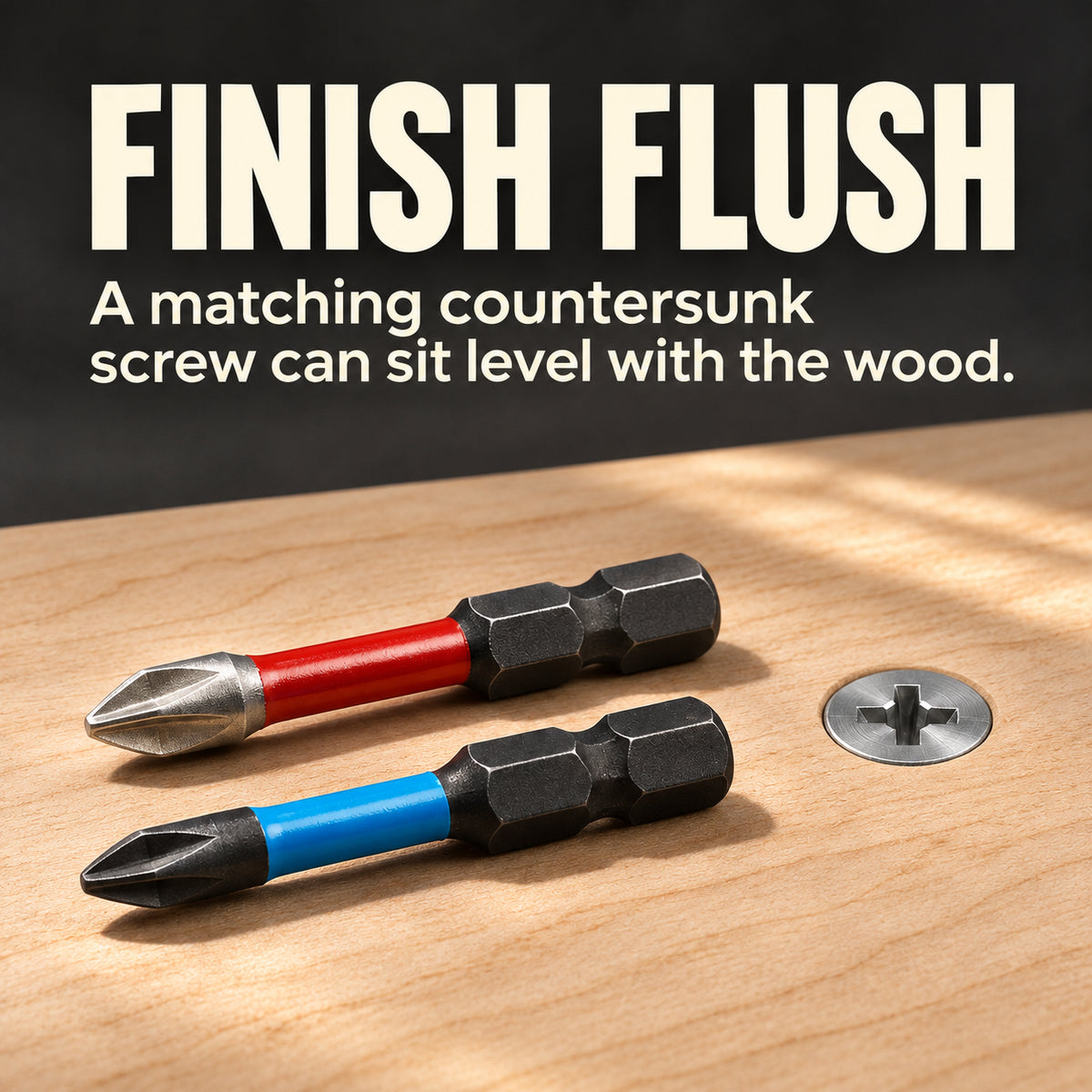
A Clean Flush Screw Finish.
Good woodworking details are easy to appreciate. When a matching countersunk screw is properly driven into prepared wood, the head can sit flush with the surrounding surface for a tidy appearance.
A flush screw head can create a neater completed joint.
Choosing the appropriate crosshead tip helps achieve proper engagement.

The Two-Bit Design at a Glance.
- Original Product Name
- Bluetooth Screw
- Illustrated Components
- Red & Blue Driver Bits
- Tip Style
- Crosshead
- Shank Design
- Hex Profile
- Red Bit Appearance
- Silver Tip & Red Band
- Blue Bit Appearance
- Dark Tip & Blue Band
- Illustrated Driver
- Cordless Bit Driver
- Example Fastener
- Crosshead Wood Screw
- Demonstration Setting
- Wooden Workbench
- Additional Scene
- Cedar Garden Planter
Frequently Asked Questions.
What does the two-bit demonstration show?
It shows a red crosshead bit positioned in a cordless driver and a separate blue crosshead bit seated in a screw. The images illustrate their respective positions and the gap between them.
What kind of screw tips are pictured?
Both colored bits have crosshead-style tips, shown alongside matching crosshead screws used in woodworking.
Do the bits have hex-shaped shanks?
Yes. Both illustrated bits have hex-profile shanks intended for a compatible bit holder.
Can the driver transmit torque wirelessly to the other bit?
The pictures illustrate a separated two-bit concept but do not demonstrate an electronic drive mechanism. Screwdriving requires a suitable powered or manual mechanical connection to turn the fastener.
A Different Look at a Familiar Tool.
Two distinct crosshead bits, contrasting colors and an unusual workbench demonstration. Explore the details of the red-and-blue bit concept, from its hex-shank profiles to its woodworking presentation.
NC0311