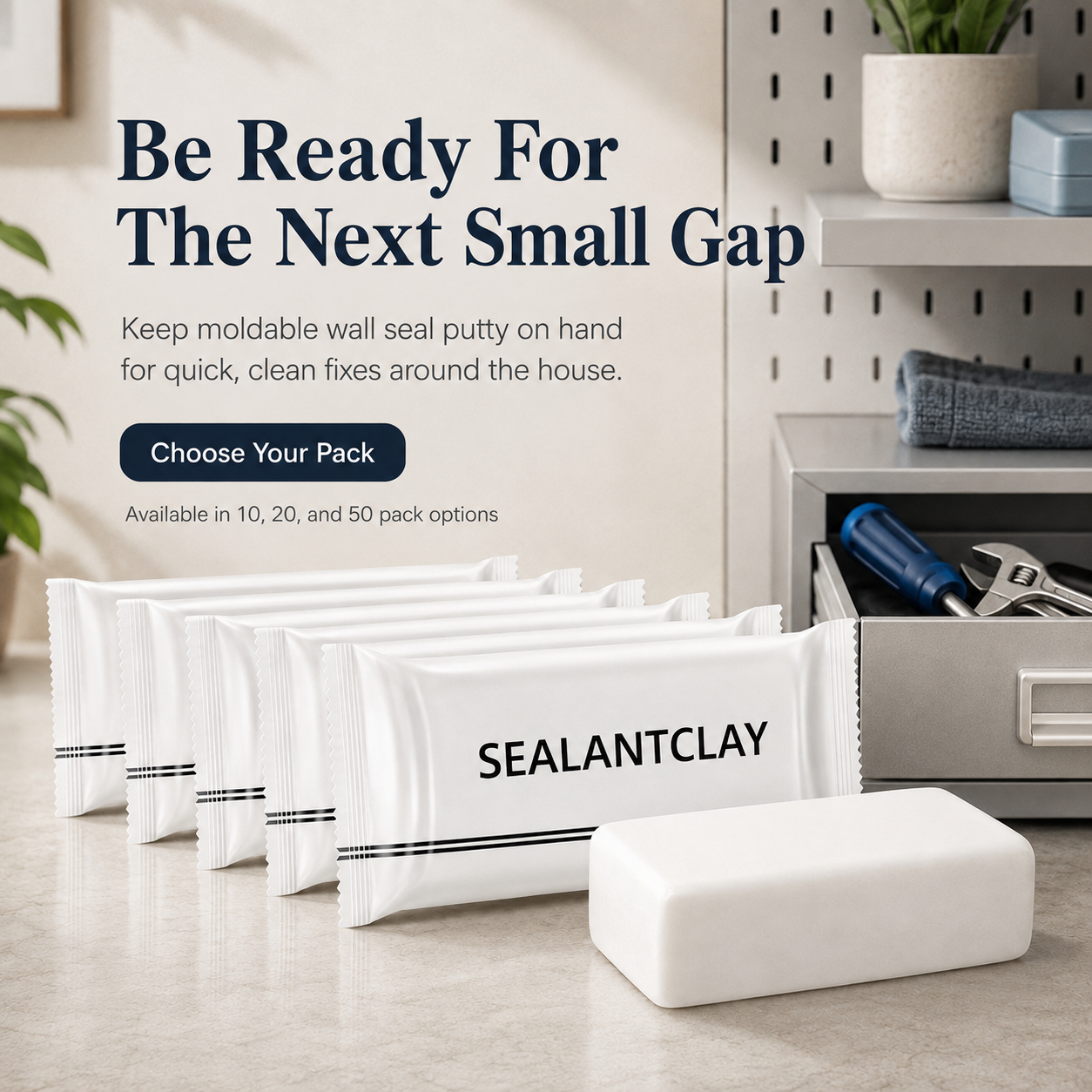
Moldable Waterproof Repair Sealing Clay
Moldable Waterproof Repair Sealing Clay

BUNDLE & SAVE
Couldn't load pickup availability

Moldable Waterproof Repair Sealing Clay
Small Gaps Shouldn’t
Turn Into Big Annoyances.
Mold this ready-to-use sealing clay around pipes, ducts, cables and awkward wall openings for a cleaner finish and a simple way to help close unwanted gaps.

Doesn’t Have To Stay That Way.
Openings around ducts, cables and household fixtures can look unfinished while also leaving room for unwanted air, moisture and odors to move through.

Fill The Space
People Keep Noticing.
Press the clay into irregular edges around household openings to cover awkward voids and create a more finished-looking transition between the wall and fixture.
-
✓
Make unfinished openings look more intentional.
Fill visible gaps instead of leaving broken or uneven edges exposed. -
✓
Conform to shapes ordinary patches may struggle with.
Moldable material can be pressed around curves, corners and uneven spaces. -
✓
Fix the little problem while it is still little.
Keep sealing clay on hand for the next small opening that needs attention.

Your Repair Material
Should Adapt To The Opening.
The soft texture can be kneaded and shaped by hand, making it easier to work into irregular spaces where a rigid patch would be awkward.
-
✋
Shape it with your fingers.
Knead the clay until it suits the space you need to fill. -
≈
Follow uneven edges.
Press it into cracks, curves and gaps rather than forcing one fixed shape to fit. -
○
Smooth the visible surface.
Finish the outer edge by hand before leaving the material to cure.

Create A More Protective
Barrier Around Small Openings.
Once fully cured, the sealing material becomes water-resistant and helps close minor pathways where moisture, odors or unwanted airflow could otherwise pass through.
-
💧
Helps resist occasional moisture.
Useful around suitable household openings once the material has fully cured. -
≈
Helps close small air pathways.
Fill open spaces around pipes, ducts and cable pass-throughs. -
○
Helps reduce odor pathways through gaps.
Closing an opening can help separate one side of the wall or fixture from the other.
Intended for suitable small sealing applications, not continuously submerged areas or structural repairs.

Open.
Shape.
Press Into Place.
Skip liquid mixing and complicated application equipment. The putty is designed to be shaped directly by hand and pressed where you need it.
Prepare The Area
Make sure the surface is reasonably clean and free from loose dust, grease or debris.
Knead & Shape
Work the clay by hand and form enough material to match the opening you want to fill.
Press Into The Gap
Push the material firmly into and around the opening so it follows the surrounding edges.
Smooth & Let It Cure
Shape the visible surface to the finish you want and allow sufficient curing time before exposing it to demanding conditions.

Keep It Ready For
The Next Awkward Gap.
The moldable format is especially useful around openings where pipes, wires or ducts pass through walls, cabinets or other household surfaces.

One Repair Material
For More Than One Room.
Use the putty on suitable clean surfaces commonly found around household repair areas.
Drywall
Concrete
Brick
PVC
Metal
Ceramic
Glass
Wall Gaps

Choose The Pack
That Fits Your Fix List.
Use a smaller pack for occasional household gaps, or stock up when you have several rooms, repairs or properties to work through.
A Simpler Way To Handle
The Gaps You Keep Putting Off.
-
✋
Shape the repair instead of forcing the gap to fit the product.
Moldable texture works around curves, corners and irregular openings. -
🔧
Skip complicated preparation.
No liquid mixing or special dispensing tool is required for normal application. -
💧
Add a water-resistant barrier after curing.
Useful for suitable small openings where occasional moisture may be present. -
🏠
Use one product across multiple household problem spots.
Suitable applications include pipe openings, duct gaps, cable holes and wall voids. -
✓
Make the finished area look cleaner.
Smooth the visible material before curing for a neater transition around the opening.
Product Details.
| Product Type | Moldable Repair Sealing Clay / Putty |
| Color | White |
| Approx. Block Size | 10 × 6 × 2.4 cm / 3.94 × 2.36 × 0.94 in |
| Texture | Soft & Moldable Before Curing |
| Finish | Water-Resistant After Full Cure |
| Approx. Cure Time | 3–5 Days Depending On Thickness, Temperature & Humidity |
| Suitable Surfaces | Drywall • Concrete • Brick • PVC • Metal • Ceramic • Glass |
| Common Applications | Duct Gaps • Pipe Openings • Cable Holes • Wall Cracks • Small Voids |
| Pack Options | 10 Pack • 20 Pack • 50 Pack |
| Application | Knead • Shape • Press • Smooth • Cure |
| Great For | Home Repairs • Utility Rooms • RVs • Maintenance Kits • Small Sealing Jobs |
This product is intended for suitable non-structural sealing applications. It is not designed for structural cracks, high-pressure plumbing leaks, permanently submerged areas, actively moving joints or applications requiring long-term flexibility. Allow the material to cure fully before painting or exposing it to demanding moisture conditions.
Sealing Clay FAQ.
Do I need to mix anything before using it?
No. The clay is designed to be kneaded and shaped directly before being pressed into the opening.
Is it waterproof?
After fully curing, the material is water-resistant and can help protect suitable small openings from occasional moisture. It should not be used as a substitute for a dedicated repair in continuously wet, submerged or high-pressure leak areas.
How long does it take to cure?
Approximate curing time is 3–5 days, although thickness, room temperature, humidity and application conditions can affect the actual time.
What surfaces can I use it on?
It is suited to common stable surfaces including drywall, concrete, brick, PVC, metal, ceramic and glass. Clean the application area before use.
Can I use it around pipes and air-conditioning ducts?
Yes. Small spaces around pipe and duct pass-throughs are among the intended household uses, provided the area is stable and appropriate for this type of sealing material.
Can it be painted?
It can be painted after it has completely cured. Test the chosen paint on a small area first to confirm compatibility and appearance.
Can it be removed later?
For suitable applications, cured material can generally be cut or pulled away if access or adjustment is later required.
Where should I avoid using it?
Avoid structural repairs, unstable or moving joints, high-pressure leaks, constantly wet locations and any area where a flexible professional sealant or code-compliant repair is required.
Keep A Simple Fix
Within Reach.
Knead it, shape it and press it where ordinary household openings need a cleaner, more complete finish.
CHOOSE YOUR PACK ↑